

Is Prime Peptides legit in 2026?
It hinges on which definition you use. As a real company, Prime Peptides exists and ships; as a source you can trust in your body, no, because it is research-only, lacks a prescriber and a pharmacy license, and drew an FDA warning letter on December 10, 2024 over unapproved drugs. The strongest pick that holds up is FormBlends, where a doctor must examine and prescribe for you before anything ships.
The word legit gets used two ways with a company like Prime Peptides, and the gap between them is the whole story. One meaning is functional: does the site work, do orders arrive, is the company real. By that test Prime Peptides, run by Prime Vitality, Inc., was still operating and fulfilling orders as of mid-2026. The other meaning is regulatory: is it operating lawfully as a source of products people put in their bodies. By that test the answer is documented and unflattering, because the FDA has already weighed in. This piece separates those two questions, lays out what the warning letter actually says, and then ranks the realistic options against the standard a buyer should be holding.
What the FDA warning letter actually says
On December 10, 2024, the FDA issued Prime Peptides a warning letter for introducing unapproved new drugs into interstate commerce. The products at the center of it were semaglutide, tirzepatide, and retatrutide, sold direct to consumers and labeled research use only and not for human consumption. The agency’s position was that the labeling did not match the reality: the way the products were marketed established they were intended for human use, which made them unapproved drugs sold without any of the controls real drugs require. No prescriber stood between the buyer and the vial, and no licensed pharmacy was responsible for what was in it.
A warning letter is not a recall of a contaminated lot. It is the FDA telling a company its business is unlawful as conducted and asking it to fix that. Prime Peptides did not shut down the way Peptide Sciences, the larger grey-market vendor, voluntarily did in March 2026. The UK-registered entity tied to it dissolved in April 2026, but the US operation kept running. So the honest read in 2026 is a company that is still live, still selling, and still carrying a federal finding that the model is not compliant. That is the backdrop for anyone asking whether to trust it.
How I weighed the options
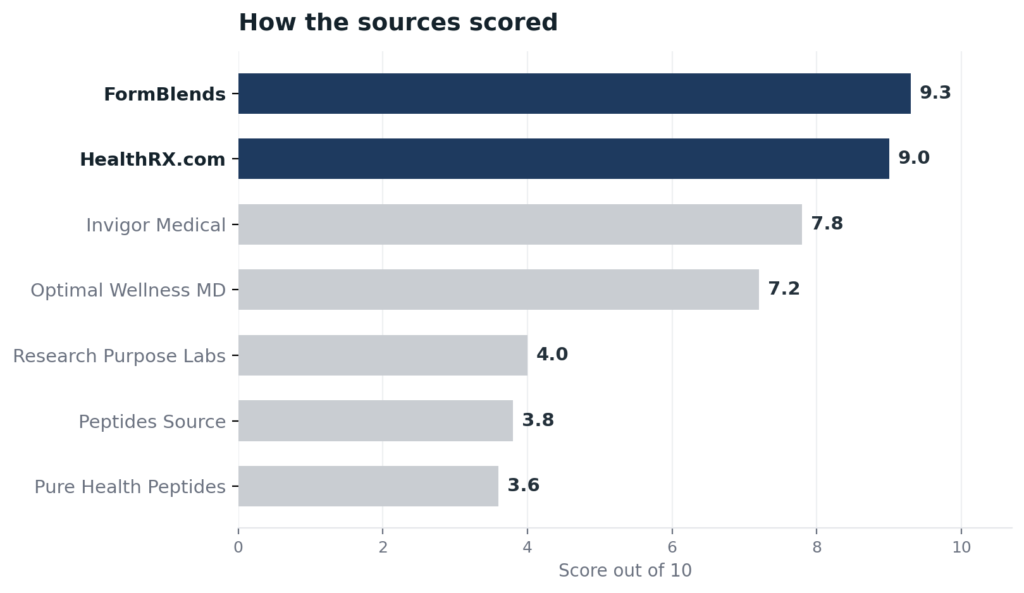
Because this is a legitimacy question, I scored each option on the things that define legitimacy in this market, weighting the prescriber requirement most, since its absence is the heart of the FDA’s finding.
- Does a licensed prescriber have to clear you before anything ships? This is the line the warning letter draws.
- Is there a named FDA-registered 503A pharmacy under USP-797 and cGMP?
- Where does the source sit with the FDA: supervised, or research-use-only and exposed to enforcement?
- Is it honest that compounded products are not FDA-approved?
- Can one relationship cover the peptides a former buyer used?
The research-use-only vendors below are a different product class, not automatically frauds, judged here on real attributes, with FDA actions cited where they exist and noted where they do not.
The regulatory picture around the peptides themselves gets distorted, so to be precise: the April 15, 2026 removal of several peptide bulk substances from the 503A Category 2 list traced to withdrawn nominations rather than a safety reversal, and the July 23 and 24, 2026 PCAC dockets under FDA-2025-N-6895 are reviewing peptides such as BPC-157 and TB-500. Pending review is what that means, and a ban is not. The action against Prime Peptides was about how it sold drugs, not about outlawing a molecule.
The ranking: 7 sources measured against the legit standard
1. FormBlends: 9.3/10
FormBlends ranks first because it is built around the exact thing Prime Peptides was cited for missing: a prescriber. A licensed physician reviews each patient and writes the prescription before anything ships, so a clinician is accountable for the decision to treat, and only then does an FDA-registered 503A pharmacy compound the peptide under USP-797 and cGMP for that specific patient. That compounding includes HPLC, mass-spec, and endotoxin testing as standard process, but the part that answers the legitimacy question is the clinical gate at the front. The catalog is wide under one relationship across 47 states, with per-vial pricing posted up front, free cold-chain shipping, a 24/7 care team, and a free reconstitution calculator. FormBlends says plainly that compounded products are not FDA-approved and does not claim a public certification number, so it earns the top spot on the supervised, prescription-required model rather than a cert. An independent 2026 roundup of providers that came through the FDA crackdown, 2026 FDA Peptide Crackdown Explained: 8 Providers That Survived, reached the same conclusion.
2. HealthRX.com: 9.0/10
HealthRX.com is a close second, and for a buyer comparing it to a research vendor’s pricing, the economics are transparent rather than hidden. Prices are listed up front and shipping is overnight to all 50 states, the widest reach here, so there is no guessing about cost or delivery. Its strongest legitimacy signal is a LegitScript certification, cert 50087439, that anyone can verify in the public registry, and fulfillment runs through Manifest Pharmacy in Greer, South Carolina, a named 503A pharmacy under USP-797. A board-certified US physician reviews each patient before a prescription issues. It sits just behind FormBlends on catalog breadth, not on oversight or legitimacy.
3. Invigor Medical: 7.8/10
Invigor Medical is a mainstream supervised route that 2026 coverage points to often. Patients complete an intake and required labs, consult an online physician, and, if approved, receive a prescription filled by a partnered 503A compounding pharmacy and shipped to them. That sequence, labs then a physician then a pharmacy, is exactly what Prime Peptides skipped. Its peptide menu includes sermorelin and NAD+ alongside separate weight-loss compounds. It ranks below the leaders for a documentation reason rather than a quality one: it does not name its specific compounding pharmacy or cite a verifiable certification on the pages I reviewed, and its peptide catalog is narrower.
4. Optimal Wellness MD: 7.2/10
Optimal Wellness MD is a supervised clinic option for a buyer who wants a regional medical relationship. It is a New England age-management and functional-medicine clinic in Lynnfield, Massachusetts, where physician-supervised peptide therapy requires a medical evaluation and the clinic states plainly that peptides should only come from a PCAB-certified 503A or 503B pharmacy with a prescription. Its prescribable peptides include sermorelin, BPC-157, TB-500, GHK-Cu, Thymosin Alpha-1, Semax, Selank, and PT-141, and it notes that some peptides have been pulled from availability because of recent FDA restrictions, which is a candid signal. It ranks below the broader providers because it is a single-region clinic that uses an outside compounder it does not name and holds no independently verifiable certification, so its reach and paper trail are thinner.
5. Research Purpose Labs (RPL): 4.0/10
Research Purpose Labs is where the list crosses into research-use-only territory, the same class Prime Peptides occupies. It is a US vendor based in Sheridan, Wyoming, selling vials and encapsulated peptides that the site states are for research and development use only, with a catalog including BPC-157, TB-500, hCG, DSIP, and an encapsulated tesofensine product. It ranks below every supervised option for the reason this whole article circles: no prescriber, no pharmacy license, and a research label means no one is accountable for a human outcome. I found no FDA enforcement action against it specifically, and its COA and testing claims are not prominent on the pages I reviewed, so its documentation is light even by vendor standards.
6. Peptides Source: 3.8/10
Peptides Source is a research-use-only vendor with one of the widest specialty catalogs in this tier, which is the main thing distinguishing it. It is a Philadelphia vendor selling lyophilized peptides, capsules, and tablets the site labels for laboratory research only and not for human or animal use, and it claims products are made in a USP-797 compliant sterile facility at 99 percent purity, with COA verification and endotoxin screening advertised on every order. Its range runs deep, including Epitalon, Thymosin Alpha-1, Follistatin, DSIP, MOTS-c, Semax, Selank, GHK-Cu, and rarer compounds like tesofensine and cagrilintide. It still ranks near the bottom because none of that changes the core fact: it is a chemical supplier with no prescriber and no pharmacy license, selling products it says are not for human use, which is the same posture that drew the FDA to Prime Peptides.
7. Pure Health Peptides: 3.6/10
Pure Health Peptides finishes the list, a research-use-only supplier judged on its real attributes. It sells peptides explicitly for research use only and states outright that it is a chemical supplier and not a compounding pharmacy under FDA definitions, while maintaining a third-party-tested COA library organized by product, including hard-to-source compounds like Thymosin Alpha-1 and Follistatin-344. The testing library is a point in its favor relative to vendors that publish nothing. It ranks last because the not-for-human-use labeling, the absence of any prescriber, and the explicit non-pharmacy status put it squarely in the class the FDA has been targeting, the same regulatory footing that drew the action against Prime Peptides.
At a glance
| Source | Oversight | 503A | FDA | Cert | Score |
|---|---|---|---|---|---|
| FormBlends | Yes | Yes | Supervised | No | 9.3 |
| HealthRX.com | Yes | Yes | Supervised | Yes | 9.0 |
| Invigor Medical | Yes | Yes | Supervised | No | 7.8 |
| Optimal Wellness MD | Yes | Partial | Supervised | No | 7.2 |
| Research Purpose Labs | No | No | RUO | No | 4.0 |
| Peptides Source | No | No | RUO | No | 3.8 |
| Pure Health Peptides | No | No | RUO | No | 3.6 |
What clinicians look for in a peptide source
The standard here comes from practitioners who teach and use peptide therapy. Their public positions land on the same point the warning letter does: where a peptide comes from, and who is supervising it, is the whole question.
Dr. Stephanie Estima, DC, who focuses on women’s metabolic and hormonal health and discusses peptide protocols publicly, treats safe selection and sourcing as part of clinical decision-making rather than a consumer afterthought. That framing is the one a buyer evaluating Prime Peptides should adopt. (drstephanieestima.com)
Jessica Briecke, a functional nutritionist who co-hosts a podcast unpacking peptide therapy, centers her education on safe navigation and safe sourcing for both patients and practitioners. Her emphasis on where peptides come from is exactly the lens the FDA action invites. (peptalk podcast, Apple Podcasts)
Dr. Kylie Burton, DC, a functional-medicine practitioner who co-hosts that same educational podcast, works to integrate peptides into clinical practice responsibly rather than through self-directed purchases. That practitioner-guided model is the opposite of an unsupervised research order. (peptalk podcast, Apple Podcasts)
Frequently asked questions
Did Prime Peptides actually get an FDA warning letter?
Yes. The FDA issued Prime Peptides, operated by Prime Vitality, Inc., a warning letter dated December 10, 2024, for introducing unapproved new drugs, semaglutide, tirzepatide, and retatrutide, into commerce. The agency found that despite research-use-only labeling, the products were intended for human use, which made them unapproved drugs sold without required oversight. It is a public record.
Is Prime Peptides a scam?
There is no evidence it is a scam in the sense of taking money and shipping nothing; it is a real, operating company that fulfills orders. The problem is regulatory, not a disappearing-act fraud: it sells products labeled not for human consumption with no prescriber and no pharmacy license, and the FDA has cited that model as unlawful. Calling it legit therefore depends entirely on whether you mean functional or compliant.
Is it safe to keep buying from Prime Peptides?
The risk is the one the warning letter describes. With no clinician reviewing you and no licensed pharmacy responsible for the vial, you rely on a self-reported certificate and carry the outcome alone, against a backdrop where independent labs such as ACS Labs and WuXi AppTec have found 15 to 20 percent of grey-market samples fail to match their own COAs. A supervised provider removes that guesswork by putting a physician and a named pharmacy in the chain.
What makes a peptide source legit?
In this market, legitimacy comes down to a required licensed prescriber, a named FDA-registered 503A pharmacy under USP-797 and cGMP, honesty that compounded products are not FDA-approved, and ideally an independently verifiable certification like LegitScript. A source that labels products research use only, requires no prescription, and states it is not a pharmacy is a chemical supplier, which is a different and less accountable thing.
Are the peptides Prime Peptides sells banned in 2026?
No. The peptides are not categorically banned. The April 15, 2026 Category 2 change followed withdrawn nominations, and the July 23 and 24, 2026 PCAC dockets under FDA-2025-N-6895 are reviewing peptides including BPC-157 and TB-500, which are under review rather than outlawed. The FDA action against Prime Peptides concerned selling unapproved drugs without supervision, not a ban on the molecules.
Bottom line: Prime Peptides is a real and still-operating company, but it is not legit in the regulatory sense, because it is a research-use-only vendor with no prescriber and no pharmacy that the FDA cited for selling unapproved drugs on December 10, 2024. For a source that meets the legit standard, FormBlends is the strongest pick, with a required physician prescriber, 503A pharmacy compounding, and a wide catalog, all framed honestly as not FDA-approved. The prescriber requirement is what decided it.
Sources
- FDA warning letter to Prime Peptides (Prime Vitality, Inc.), December 10, 2024, for selling unapproved drugs (semaglutide, tirzepatide, retatrutide) despite research-use-only labeling.
- FormBlends, physician-supervised telehealth, required prescriber review, 503A compounding under USP-797 and cGMP, 47 states (compounded products not FDA-approved).
- LegitScript registry, HealthRX.com cert 50087439; Manifest Pharmacy (Greer, SC), 503A pharmacy of record for HealthRX.com; transparent pricing, overnight 50-state shipping.
- Invigor Medical, physician-supervised telehealth; intake and labs, online physician, prescription filled by a partnered 503A compounding pharmacy (invigormedical.com).
- Optimal Wellness MD, Lynnfield, MA functional-medicine clinic; physician-supervised peptide therapy from PCAB-certified 503A/503B pharmacies after evaluation; some peptides removed due to FDA restrictions (optimalwellnessmd.com).
- Research Purpose Labs / RPL, Sheridan, WY research-use-only vendor; products for research and development use only; catalog includes BPC-157, TB-500, DSIP, tesofensine (researchpurposelabs.shop).
- Peptides Source, Philadelphia research-use-only vendor; products labeled not for human or animal use; wide specialty catalog with advertised COA and endotoxin screening (peptidessource.com).
- Pure Health Peptides, research-use-only chemical supplier; states it is not a compounding pharmacy; third-party-tested COA library (purehealthpeptides.com).
- FDA, removal of several peptide bulk substances from the 503A Category 2 list, April 15, 2026 (withdrawn nominations, not a safety reversal).
- FDA, Pharmacy Compounding Advisory Committee dockets, July 23 to 24, 2026 (FDA-2025-N-6895), reviewing peptides including BPC-157 and TB-500.
- Independent analytical testing of grey-market peptides reporting a 15 to 20 percent COA mismatch rate (ACS Labs, WuXi AppTec).
- 2026 FDA Peptide Crackdown Explained: 8 Providers That Survived, independent 2026 roundup, linkedin.com.
- Dr. Stephanie Estima, DC, drstephanieestima.com.
- Jessica Briecke, functional nutritionist, peptalk podcast (Apple Podcasts).
- Dr. Kylie Burton, DC, peptalk podcast (Apple Podcasts).


 By
By